Book Review: The Poet Empress by Shen Tao
ARC provided by the publisher—Tor Books and Gollancz—in exchange for an honest review.

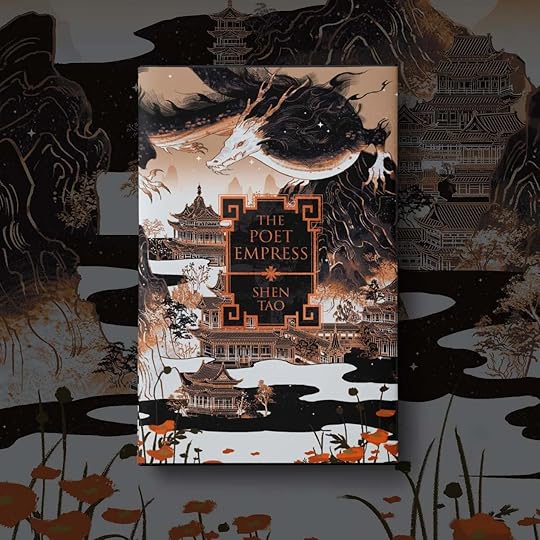
Cover art by Kelly Chong
The Poet Empress by Shen Tao
My rating: 5 of 5 stars
Series: Standalone
Genre: Fantasy, High Fantasy, Epic Fantasy
Pages: 398 pages (Hardcover Edition)
Word Count: 139,000 words
Published: 20 January 2026 by Tor Bramble (US) and Gollancz (UK)
I am in awe. The Poet Empress is absolute greatness manifested. This is a must-read epic fantasy standalone masterpiece for fans of The Sword of Kaigen by M.L. Wang, The Dandelion Dynasty by Ken Liu, and Daughter of the Empire by Raymond E. Feist & Janny Wurts.
“You were born second, so you never learned the meaning of duty. You never learned that there is no glory without sacrifice. There is no greatness without suffering.”
I can’t emphasize this highly enough. To encounter a standalone epic fantasy book on this caliber is simply a blessing. For almost a decade, I’ve repeatedly put The Sword of Kaigen by M.L. Wang as the best standalone fantasy novel I’ve ever read. During this stretch of time, Wang’s masterpiece stands alone at the mountain’s peak. Today, the solitude has changed. The Poet Empress appeared like a falling star that straight up landed its position beside The Sword of Kaigen. Both of them are standing tall side by side at the top in harmony, sharing their crowns. I honestly believe a standalone epic fantasy novel as good as these two books comes only about once a decade. The Poet Empress reminded me of some of my favorite fantasy books of all time while still ensuring, without a shadow of a doubt, that it stands magnificently strong with its own identity.
“Maybe you are meant to end something bad, so that you might begin something good.”
House of the azalea, where thorn meets bud;
Brother betrays brother, blood forgets blood.
The story in The Poet Empress follows Wei Yin. After the fifth death of a sibling, with her family and village on the brink of starvation, Wei Yin is desperate, and she will do, literally, anything to save those she loves. Even if this means offering herself as a concubine to the cruel and violent heir of the blood-gutted Azalea House, where poetry magic is power, but women are forbidden to read. But to save herself and the nation, Wei Yin realizes she must survive the dangers of the court, learn to read in secret, and compose the most powerful spell of all. A ballad of love and death.
“You are still thinking like a villager, not an empress… If you refuse to be cruel, someone will be cruel to you first. If you refuse to make others suffer, then you will be made to suffer first.”
If you’ve been online in the book space, you might’ve seen some reviews or marketing that placed The Poet Empress in the romantasy space. I personally think this assessment is far from accurate. That said, I sincerely hope it continues to reach more readers who will find themselves pleasantly surprised by the excellence of this book. Even if they approached the book with the wrong expectations. Sometimes, I like to let my optimism lead me to believe that a fantastic story will eventually find its audience. Especially one born out of passion for storytelling. Like how it arrived at my doorstep six months ago. From the prose, it is easy to tell Tao poured everything she had into crafting The Poet Empress. I consider myself blessed to have read this spectacular novel.
“Everyone who tells a story leaves a part of themselves inside it, he’d say. That is what gives it power. There is the feeling from the story, and the feeling from its teller, both working together.”
The Poet Empress is a dark story. It is violent, merciless, cruel, and emotionally devastating. There’s no sugar coating it. It shows the harrowing lengths people will go to achieve greatness. The Poet Empress feels different from many fantasy books published in the past few years. I believe this is also why readers, myself included, felt that joy and book hangover from reading The Sword of Kaigen for the first time in The Poet Empress. I dare say, despite the gray area the ending thread upon, The Poet Empress actually ended more satisfyingly as a standalone.
“Put a mountain before a man, he once told me, and if he is worth anything, he is certain to climb it.”
Picture: The Poet Empress by Kelly Chong
One of my favorite elements about The Poet Empress is the way it encompasses many resonating themes within its narrative and delivers them brilliantly. Greatness, family, brotherhood, sacrifice, legacy, literature, love, and mainly, power. The lure, the pursuit of it, and the intoxication. Power corrupts, and it corrupts completely. To accomplish what she sets out to do, Wei needs to force herself through insane trials and tribulations. To kill a monster, does it mean Wei, too, must become one? Tao does not shy away from viciously putting her characters through malice, evil, and heartbreaking events. The character work and relationship dynamic are nothing short of outstanding. It felt effortless to be invested in the character’s journey. And guess what? All of these praises are not exclusive to Wei.
“It is easy to make fleeting footprints in the snow;
It is hard to make lasting marks in the stone.
Shall I dance ten thousand steps, unwitnessed?
Shall I make one carving, forever known?”
While it is true that Wei is the main POV character of The Poet Empress, she is not the only character in the spotlight. If you were to force me to choose my favorite chapters in The Poet Empress, I would have to say it is Terren and Maro’s flashback chapters. There is a saying that all children are born kind. Life, responsibility, forced obligations, and the weight of insidious expectations, sadly, have a way of feeding and staining these souls with unbridled malevolence. Tao seamlessly incorporates these masterfully written flashback chapters. The range of emotions I attained from reading the flashback chapters, especially when they are combined with Wei’s present-timeline story, knowing how far the brothers are from their initial innocence and joy, pretty much defines what I love most about reading and storytelling.
“My Ba told me once that all children are born kind, it is only later that they learn to be otherwise.”
Those who have followed my reviews for years will know by now that I consider The Dandelion Dynasty by Ken Liu as one of the masterpieces in epic fantasy. Trust me when I say that the flashback chapters and the deadly political intrigues in The Poet Empress felt redolent of Ken Liu’s way of storytelling. Additionally, Wei’s navigation through the merciless court politics and her determination to use everything in her mind, despite all the disadvantages, to triumph over her opposition and achieve her goals reminded me of the best aspects of Daughter of the Empire by Raymond E. Feist and Janny Wurts. No chapter felt wasted. Everything about The Poet Empress is breathtaking and unputdownable. It has been years since I was left this riveted and satisfied by an epic fantasy standalone novel.
“Now I understood why this vile thing, this thing that we could not even hold in our hands, this power, was something women and men fought so viciously for. Now I had tasted it for myself, and it was as sweet as peaches, as wine.”
From reading the first three chapters, I immediately knew I was reading a special novel for me. Reading is subjective. We cannot separate our respective life experiences from the enjoyment of a book. As an Asian diaspora myself, the plot and the Chinese-inspired world and magic—Literomancy—in The Poet Empress instantly clicked with me. Tensha, or the overall world-building in The Poet Empress, is heavily inspired by Imperial China. However, this does not make the book a historical fiction/fantasy. The character’s names are not all rooted in Chinese. Maro is a Japanese name. Terren is a Western name. The book doesn’t seek to be accurate to Chinese history, and I am sure it is never intended to be. The Poet Empress is certainly a high fantasy novel with Chinese influences.
“My life might be smaller than yours, but it is full of joy and worth living.”
Tao did implement Mandarin language in the literomancy magic, and I, as a reader who speaks Mandarin as a second language, found that this enhanced my reading experience. I did not know anything about Literomancy when I started reading the book. Frankly, if I had known, I would’ve read the book even sooner. How the magic works is relatively simple. For example, Prince Terren received the word 刀/Dao (Knife) as his Blessing. This means he has the power to summon—practically—infinite knives or swords as long as he has the energy to do so. If you play Final Fantasy XV, it is similar to Noctis’ power in the game. Maro’s 路/Lu (Road), on the other hand, reminded me of alchemy in Fullmetal Alchemist. They’re pretty damn cool and destructive. But it is the effect this magic has on the character’s development and the political conflict of the story that, hands down, increased the quality of the book extensively. Tao evidently demonstrated the importance of executing an idea with finesse. I won’t rob you of the experience. You just have to read and find out for yourself how superb it all was.
“I had thought it through the night before, and I understood now. Power was not always evil, the pursuit of it not always selfish. Being able to help one’s family, one’s village— that was power. Having enough provisions to dole out to starving farmers in the north— that was power. Holding the authority to question the wicked owner of a pleasure house, to seek out the truth, to protect the innocent— that was power. Remember who you are doing this for, and you will not be lost. “
Picture: The Poet Empress by Toyo Illustration

Every tremendous development and thrilling build-up; all the suffering, sacrifice, and motivation… They all came to a titanic clash at the end. Tao made sure every page of The Poet Empress was worth its 139,000 word count. The climax sequence invites readers to observe a catastrophic confrontation brimming with intensity and emotion. It is incredibly high-stakes, bloody, and epic in scope. Everything just felt exceptionally cinematic and vivid in my mind. Similar to how the best poem in the book has its immersive power, the words in this book made me feel like I was truly there inside Wei’s perspective, witnessing the twists and turns that are bloody and beautiful at the same time unfold before my eyes. I already want an animated movie adaptation of this book. Maybe this is a trope, but during the last sequence of a story, I love it when a main character reflects on the tempestuous paths they have walked to get there. Upon finishing the book, I was left dazzled and emotional. I stared at an empty wall for a while. And then I immediately reread the last ten chapters. Something I almost never did.
“If I am a star… then let me burn. Let me burn and burn until the whole empire is devoured, along with all its corruption, its villainy, its rot. Let me burn and burn until this night is not remembered, nor this year, nor this dynasty, until even history is buried in ash. And then maybe green things would grow again.”
In one debut, Tao successfully touches several of the highest accolades in my personal history of reading. The Poet Empress is the best standalone fantasy book I’ve ever read. It is up there with The Sword of Kaigen by M.L. Wang for me. It has also cemented itself as one of the best books of all time. If you crave a standalone novel with the emotional damage and climactic action sequences like The Sword of Kaigen paired with the brutal and ruthless political intrigue found in The Dandelion Dynasty by Ken Liu and Daughter of the Empire by Raymond E. Feist & Janny Wurts, you owe it to your soul to read this book. I am 100% confident that years from now, history will sing The Poet Empress as one of the finest epic fantasy standalone classics that endure the test of time. Should you choose only one fantasy book published this year, choose The Poet Empress. It is a powerful and impeccable masterpiece in every way. Poetry is truth and emotion. This review is my truth and my honest emotion about The Poet Empress.
“Truth was simpler. It was warm bowls of rice on the dinner table, enough for everyone, not only young sons who were still growing. It was families sleeping in the same room. Villagers working together, staving away demons or something worse that plagued them. It was suffering. It was enduring… It is not something you can learn from inside the palace walls.”
You can order this book from: Amazon | Blackwells (Free International shipping)
I also have a Booktube channel
Special thanks to my Patrons on Patreon for giving me extra support towards my passion for reading and reviewing!
My Patrons: Andrew. S, Arik, Arliss, Barbara, Ben, Benjamin, Cade, Chris, Crystal, Cullen, Dan, Dylan, Edward, Elias, Erich, Evie, Feanor, Francesca, Frank, Gary, Gregory, James, Jason, Jeff, Johnny, Joie, Jonathan, Katrina, Kim, Kristina, Lara, Leigh, Lourdes, Melinda, Mike, Mike S, Miracle, Mordie, Nicholas, Radiah, RCT, Sally, Samuel, Sarah, Scott, Sean, Shawn, Shawna, Stephanie, Trish, Tyler, TS, Wendy, Wick, Xero, Yuri, Zachary, Zammar.